
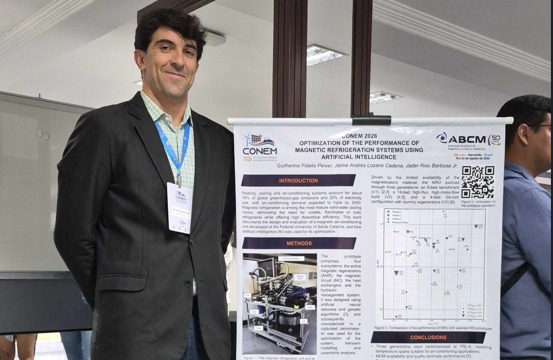
Researcher Guilherme Fidelis Peixer—an alumnus of the Graduate Program in Mechanical Engineering and a postdoctoral researcher at POLO (Research Laboratories in Refrigeration and Thermophysics)—was honored by the Brazilian Society of Mechanical Sciences and Engineering for the design, construction, and optimization of a magnetic refrigerator. This innovation, which utilizes artificial intelligence, is applied to air conditioning. The work was developed during his doctoral studies.
“Magnetic refrigeration is an alternative to conventional refrigeration that can eliminate the use of greenhouse-gas refrigerants. I developed AI models for the system’s components and integrated them with optimization algorithms, thereby reducing design time and costs,” explains Peixer. “On the experimental side, I coordinated the assembly and characterization of three generations of a prototype—one of the world’s first magnetic refrigerators capable of cooling a room under real operating conditions. The AI methods developed were subsequently applied to other areas, such as hydrogen liquefaction, carbon capture, and oil well monitoring,” he summarizes.
The results presented in the study demonstrate that artificial intelligence can play a pivotal role in advancing the commercialization of more sustainable and energy-efficient refrigeration. “This thesis represents years of work applying artificial intelligence, machine learning, and optimization to energy and thermal systems, with a common goal: advancing decarbonization and the energy transition. The methods extended to broader challenges, such as hydrogen technologies, carbon capture, utilization, and storage, and the thermo-structural stability of oil and gas wells,” the researcher stated.
The quality of his thesis earned him further recognition. Guilherme was the winner of the Brazilian stage of the competition. Falling Walls Lab 2024,representing Brazil in the final in Berlin; was highlighted by the Brazilian Academy of Sciences for the BRICS Young Innovator Prizein Russia, and received the award for best paper at the Brazilian Hydrogen Congress. The research was also conducted at Stanford University in the United States, with a CNPq scholarship and under the supervision of Professor Daniel Tartakovsky, and at the University of Ljubljana in Slovenia, with an Erasmus+ scholarship and under the supervision of Professor Andrej Kitanovski.
“I am very happy to bring this recognition to POLO and UFSC. More than just an individual achievement, this award is the result of the work of the entire new technologies team at POLO—built over more than a decade—and the guidance of professors Jader Barbosa Jr. and Jaime Lozano,” the researcher notes. The thesis, titled *Optimization of the Performance of Magnetic Refrigeration Systems using Artificial Intelligence*, was defended in December 2025. Optimization of the Performance of Magnetic Refrigeration Systems using Artificial Intelligence, foi defendida em dezembro 2025.
In addition to him, researcher Kelvin Guessi Domiciano was also recognized by the Brazilian Society of Mechanical Sciences and Engineering, receiving an honorable mention for his work.evelopment of Novel Thin Loop Heat Pipes for Electronics: Modelling and Experiments, under the guidance of Professor Marcia Barbosa Henriques Mantelli and Professor Sauro Filippeschi. The 2025 ABCM/Springer Nature Award received 63 entries, 25 of which were in the doctoral thesis category. The awards ceremony took place in August in Maranhão, during the National Congress of Mechanical Engineering.